Pages

Friday, March 16, 2018

READER COMMENTS


We are featuring three excellent comments today from Spark News readers. If you want your voice heard comments may be posted via this site or email to publicradio@hotmail.com.

Comments or questions about the accuracy of stories that appear on this blog are always welcome. Thank you for reading Spark News.

COMMENT ONE: COMMERCIAL RADIO’S FINANCIAL MESS IS AN OPPORTUNITY FOR NONCOMMERCIAL RADIO TO GROW

Image courtesy of All Access Media
On March 7th we reported on Educational Media Foundation’s (EMF) purchase of commercial giant WLUP in Chicago at the bargain price. We speculated that more commercial radio stations will be sold because of excessive debt. We said that commercial radio is devolving but they did it to themselves.

This topic is timely because on Thursday 3/15 iHeartMedia, the nation’s largest commercial station owner, announced they have filed for Chapter 11 bankruptcy protection. According to news reports, iHeart owes more the $10 billion.


We received a comment from an anonymous reader challenging our assumptions. The reader seems optimistic about the future for Cumulus Media (an now iHeart, after the bankruptcy process is completed:

READER: [Filing for Chapter 11] reorganization…will leave their networks of licenses mostly (if not entirely) intact but will discharge most (possibly 75%) of their debt. Why would they suddenly feel the need to sell their licenses to pay off debt? There won't be any debt!

KEN SAYS: In a perfect world the reader is correct.  But once a bankruptcy petition is filed the process goes through a number of stages before a company emerges debt free. According to several sources, only around 15% of entities that file for Chapter 11 are successful.  Many of the companies that file for Chapter 11 are forced into Chapter 7 – liquidation.

There are advantages for a creditor to push Chapter 11 proceedings into Chapter 7. It may be the best way to recover a larger portion of the money they are owed. The money owed by iHeart and Cumulus is so large it is hard imagine certain creditors won’t push for total liquidation.

EMF HQ in Rocklin, California
READER:  Even if they weren't discharging their debt, selling off properties is counterproductive if you want to discharge debt. Most of these stations have amortized their value over time, but if they sell them now for cash, they'll owe the taxes on the full market value of the license. Trying to sell a lot of these licenses would guarantee a loss on the balance sheet...not a good way to pay off debt.

KEN SAYS: Again, the reader’s comments are true but they are only part of the story. Keep in mind that iHeart and Cumulus are in bankruptcy because they could not profitably operate their businesses. 

The bankruptcy court and creditors must confirm that companies in Chapter 11 have a rock-solid plan for solvency before the company can emerge from bankruptcy. iHeart and Cumulus may have trouble demonstrating that their post-bankruptcy plans will actually work. This may require iHeart and Cumulus tho divest under-performing stations.

READER: After all that, who does that leave to buy these…signals? Mostly [noncommercial] public radio and religious radio. Public radio usually doesn't need these signals and can't realistically afford them.

KEN SAYS: This is not true. Public radio does need more signals. Many sizeable markets don't have Triple A  stations or even Classical stations. Sale prices in recent station transactions have been dropping. 

The filings by iHeart and Cumulus for Chapter 11 will further reduce the perceived value of some stations. So, there will likely be more surprising purchases of commercial stations at “fire sale” prices by noncoms in the near future.

COMMENTS TWO & THREE: SIRIUS XM GIVES PRODUCERS FREEDOM BUT LISTENING TO SXM IS LIKE GOING TO WALMART

We received excellent comments from two Spark News readers about our coverage of Sirius/XM’s (SXM) impact on terrestrial radio and that there are some important similarities between SXM and noncommercial stations.

• Shawn Rosvold, a former producer for SiriusXM, now based at KRCC, Colorado Springs, asked that we consider the positive aspects of SXM:

Shawn Rosvold
ROSVOLD: I read your article on Sirius XM with interest. I produced the Jay Thomas Show for five years. As a broadcaster, Sirius XM is heaven. The facilities are state of the art, and the freedom we were given was unmatched in my 50 years of experience.

Ratings information was never shared with us. In fact, I was told that Sirius did not subscribe to ratings services, and that they were only concerned with total subscribers.

As far as the corporate mindset [at SXM] goes, I don't really see much difference between commercial and non-commercial radio. My time at Sirius came to end because I was making too much money. It doesn't get much more bottom line than that.

Fred Fletcher-Fierro
Fred Fletcher-Fierro, based at KRPS in Pittsburg, Kansas, who says the Sirius and XM provided better programming before the two companies merged in 2008:

FLETCHER-FIERRO: I read your SiriusXM post last week with much interest as I have read the Message Boards at XMfan.com for over a decade and have commented on the site just over 9 years.

When I think of SiriusXM, I don't think of the Mall Of America. Maybe it was thought of that way pre-merger in 2008, when Sirius and XM catered to a very specific type of customer, the way that stores in the mall do.

But these days, SiriusXM is more of a Walmart type of operation. I say that because Walmart, carries almost everything. You can buy a wedding ring and get your oil changed at the same Walmart within an hour.

As you've pointed out, SiriusXM has very limited public radio content and could care less about updating information on their website. That has always been a problem with the company.

Another issue is hardware. Sirius and XM still operate on two different platforms. Sirius is limited to 184 channels, while certain XM receivers get channels as high as 468. 

KEN SAYS: Thank you Shawn and Fred.  I learned a lot about SXM from your comments. The bottom line is that SXM is profitable and will be a competitive factor for terrestrial radio for the foreseeable future.

I like that SXM can/will provide specialty programming like The Beatles Channel, Road Trip Radio and The Covers Channel. These could never succeed on 24/7 terrestrial radio stations.

I agree with Fred that SXM is more like Walmart than the Mall of America, a corporate space that is hard to embrace but has stuff you need at low, low prices.


Thursday, March 15, 2018

WILL NEW MANAGEMENT CHANGE THE SLEEPY CULTURE AT AT KALW?


One of the most anticipated job searches in public radio may be completed soon when if/when a new GM is hired at KALW, San Francisco [link]. i

The reason we say “if” is because the process has taken quite awhile despite the size of the candidate pool.

The opening became widely known when KALW purchased a “help wanted” ad [link] written by still-current GM Matt Martin.  The title of Martin’s essay was Take My Job - Please!
Martin’s personal pitch was notable because he was unusually candid in his description of his job and why he had chosen to leave a place where he likes to work:

KALW GM Matt Martin
“I will start with this: Being General Manager of KALW is a big job. It’s challenging. It takes guts. For more than a decade, I’ve had a great time doing it.”

“I do believe there is huge potential and important work to be done at KALW, and I am confident there is someone who can embrace the work and help the station take its next step forward in a way I simply can’t.”

“We are licensed to the San Francisco Unified School District. Understandably, the school board is limited in the attention it can give KALW. So job #1 for the next leader of KALW will be to launch a 501(c)(3) “Friends” group. Not having made it happen is my greatest regret.”

When asked by Spark News whether the job was still open, Martin replied with a very short email message:

Not yet, but we are getting close!

So, the situation now is as clear as mud.

THE OPPORTUNITY VS. THE REALITY ON THE GROUND

Martin understates both the opportunity and reasons KALW lags far behind other stations in similar situations. KALW is a small station in a big market with total revenue in FY 2016 of $2.496 million. Members and underwriters provided 71% of the revenue, a sign of a very healthy station. CPB funds make up only 5% of the annual revenue.  The School District provides in-kind support.

By contrast, crosstown KQED FM & TV report of $70 million in revenue during the same year.


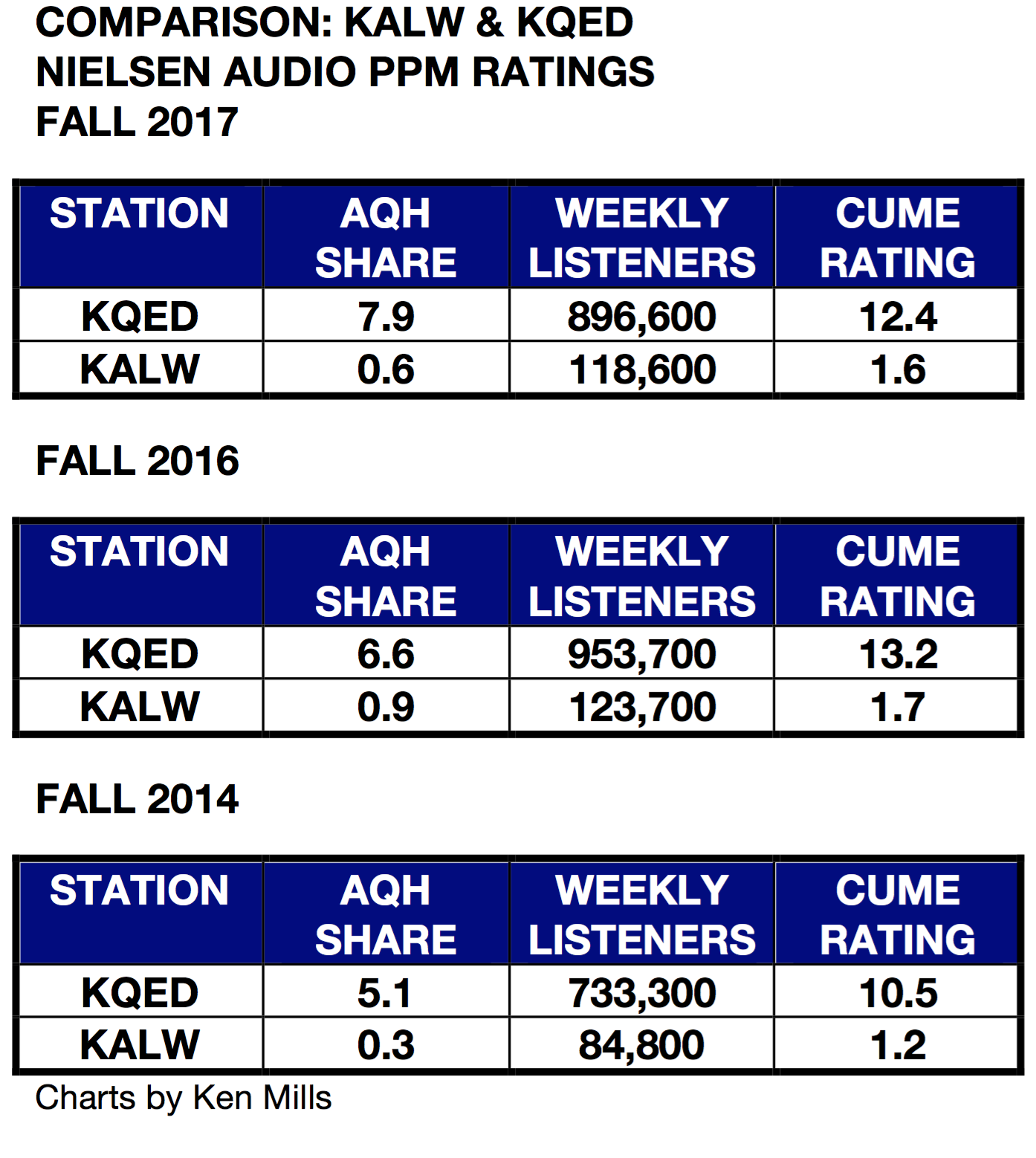
KALW’s ratings are unusually small compared to other stations in the market, particularly KQED. On the left is a chart the compares the Nielsen ratings performance of both KALW and KQED from IN Fall 2014, 2016 and 2017 in three key metrics. 

KQED often has the largest number of estimated weekly listeners of any NPR News/Talk station in the country.  KQED’s Cume Rating, a measure of market penetration, was an amazing 12.4% in Fall 2017. I call this metric “the community importance factor."  KQED is a very, very important factor in San Francisco.

KALW is a much less of an important factor. Their cume rating of 1.6 shows that KALW is “forgettable media” to most of the people in the Bay area. Both stations have huge coverage areas, so that is not the problem.

To me, KALW’s insignificance is due the fact that the people there now like it this way,

There are very talented folks working at KALW but the station – as a whole – seems to be locked in a sleepy status quo. Changing this corporate culture will be a big challenge for the new GM because it is deeply ingrained at KALW.

Yes, there are substantial opportunities for KALW. Hypothetically, KALW could compete with KQED the way WGBH has challenging WBUR. Dual formats are another possibility -- look at the success KCRW has in Los Angeles and KNKX has in Seattle.

Moving forward, will KALW continue the sleepy status quo or will it find the guts to be great.

Wednesday, March 14, 2018

INFINITE DIAL 2018: IS THE DRAWING POWER OF FACEBOOK FADING?


One of the most interesting trends revealed by Infinite Dial 2018 is the decline in usage of the social media site Facebook. According to a February 12 post on Recode [link], eMarketer found that Facebook lost 2.8 million users under the age of 25 in 2017.

This trend was echoed by the Edison Research and Triton Digital study Infinite Dial 2018. According to their survey of 2,000 people age 12+, the percentage of respondents using Facebook declined from 65% in 2017 to 62% in 2018. This is the first time since Facebook began in 2008 that the percentage of users dropped.


The change in Facebook usage was the most profound with folks 12 – 34 where usage fell 12 percentage points, from 79% in 2017 to 67% in 2018. 

The only demo where Facebook usage was steady was with people age 55+.


 In addition to Facebook’s decrease in users, Infinite Dial 2018 found that the entire category of social media sites fell 3% in 2018 compared with 2017.


Within the social media category, brands/sites gaining usage in 2018 were Instagram, Pinterest and Snapchat. Twitter also lost usage share, down 2% in 2018 from 2017.


SMARTPHONES CONTINUE TO LEAD DEVICE OWNERSHIP


Infinite Dial 2018 found that Smartphone ownership continues to grow. An estimated 233 million people, 83% of the US population age 12+ owned at least one Smartphone in 2018. 

The penetration of Smartphones over the past decade is quicker than any other media device in recent history.


Meanwhile Tablet ownership dropped for the first time since the device was introduced in 2012. 

Tablets continue to be a major factor because an estimated 141 million people own at least one.


The much-hyped Smart Speakers made impressive gains in ownership between 2017 and 2018. 

However, the market penetration of Smart Speakers is relatively small compared to other, more established devices.


YouTube usage continues to grow. Almost half of people age 12+ used YouTube during the previous week – an estimated 129 million users.

Infinite Dial is important because it has become the recognized baseline data about the market penetration of various media platforms and devices. You can see a recording of the presentation of Infinite Dial 2018 here. You download the presentation slides here.

MORE ABOUT THE DECLINE IN FACEBOOK USAGE

The digital measurement firm eMarketer found that Facebook monthly usage by teens, ages 12 – 17, declined 9.9% in 2017 compared to 2016. 2017 was the second straight year with fewer teenage users. eMarketer projects that usage by teens is likely to fall even more in 2018, 2019 and 2020.


eMarketer found the same pattern with users ages 18 – 24, though not to the degree of teens.


The projection for additional future Facebook usage drops by folks in the younger demos reinforces the narrative that Facebook’s “cool” aura is fading. Usage by people in older demographics such as 55+ continues to slowly grow. However, Facebook appears to be a reflection of the tastes and preferences of the “mom & dad” or “grandpa and grandma” generations, a worldview many younger folks don’t want to be a part of.

There is some good news in the eMarketer study for Facebook. Because of the growing use by people in the older demographics, the total number of users will continue to go up. Also, Facebook owns Instagram which is growing with younger users. eMarketer projects that Instagram may have 105 million users by the end of 2018.

KEN SAYS: I want to thank tom Webster of Edison research and Kristin Charron of Triton Digital for their excellent work on Infinite Dial 2018. They continue to bring much needed clarity to a fast-moving scene.


Tuesday, March 13, 2018

HOUSTON ROCK JOCK IS ONE STEP AWAY FROM CONGRESS • RADIO IS STILL “KING OF THE CAR”


Dayna Steele

Radio folks have another reason to pay attention to the November mid-term elections. 

One of their own, former FM rock host Dayna Steele is the Democratic Party’s candidate for the House of Representatives from Texas’ 36th District.

Steele [link] won in the recent Texas Democrat primary by a wide margin. She will face incumbent Republican Brian Babin in November. 


The 36th District includes suburbs east of Houston to the Louisiana border, including Port Arthur and Beaumont. In recent years Republicans have easily won the district but 2018 may be different.  Representative Babin is closely aligned with President Trump and the electorate is unpredictable, so anything can happen.

Dayna Steele, called The First Lady of Rock, first became known in the Houston area as a host at former Album Oriented Rock (“AOR”) powerhouse KLOL in the 1980s and 1990s. Steele began her radio career at KAMU at Texas A&M in the late 1970s.


After KLOL, Steele became a spokesperson for NASA. She organized and participated in several community initiatives involving healthcare, education and protecting the environment. She is the author of several books including Rock to the Top: What I Learned About Success from the World’s Greatest Rock Stars, which has been getting Five Star reviews on Amazon [link].  

Etheridge (left), Crosby & Steele

Steele’s friends in the music business have been campaigning on her behalf. Rocker Joan Jett has performed at quite a few of Steele’s rallies. Legendary singer-songwriters David Crosby and Melissa Etheridge recently performed at a campaign fundraising event. Crosby told fans at the event:

"Welcome to our new super group: Crosby, Steele and Etheridge."

INFINITE DIAL - PART TWO: YOU WILL PROBABLY HEAR RADIO IN A CAR, BUT MANY HOMES DON'T EVER HAVE A RADIO TUNER

We continue with the second of three debriefs of Infinite Dial 2018, the annual study of market penetration of various media platforms and devices by Edison Research and Triton Digital. Today’s focus is terrestrial radio. (On Wednesday we will look at use of social media and mobile devices.)

Infinite Dial is important because it has become the recognized baseline data about the market penetration of various media platforms and devices.

Data in Infinite Dial 2018 was gathered in January and February 2018 from around 2000 people ages 12+ via mobile and landline telephone surveys. You can see a recording of the presentation of Infinite Dial 2018 here. You download the presentation slides here.
 
BROADCAST RADIO IS BY FAR THE TOP IN-VEHICLE AUDIO SOURCE

Terrestrial AM/FM remained the top audio source for folks behind the wheel. Among people 12+ who had driven and/or ridden-in a car during the past year (88% of the respondents), 82% listened-to or heard broadcast radio. This amount was unchanged from 2017.

Listening to other audio sources in vehicle remained steady in 2018 compared with 2017 except for podcasts. Podcast use in vehicles grew to 23% in 2018 from 19% in 2017.

BUT AT HOME, RADIO RECIEVERS ARE HARDER TO FIND

According to Infinite Dial 2018, the number of radio receivers in the average American home has dropped by a large margin in the past ten years. 

An increasing percentage of households that had no radios in the home – only 4% in 2008 and 29% in 2018. 

Also, in 2008 65% of households had between one to three radio sets. That number fell to 60% in 2018.

The most dramatic change occurred with respondents between the ages of 18 and 34.   

According to Infinite Dial 2018, only half of the households have radio sets. Ten years ago, the percentage of households with no radios in the same demo was 6%. 

This is a drop of game-changing proportions.

As you probably have read elsewhere, the ownership of Smart Speakers grew dramatically in the past year. However, the overall market penetration of Smart Speakers is still relatively low.

We noted that the researchers do not define “radio.” Is it a device that only plays AM and FM? Or is it any device that plays AM and FM and can also play other audio sources? When someone is listening to a FM station on a Smart Speaker, are they listening to “radio” or to a “Smart Speaker” or both?

Listening to radio online continues to grow each year. The percentage of respondents who said they do listen to online audio has grown from 2% in 2000 to 57% in 2018. 

Note that the researchers define “online audio” as both streaming audio of stations and streaming audio from“pure play” vendors like Pandora and Spotify. 

The researchers did not report the percentage that listened to each type of provider.


Monday, March 12, 2018

INFINITE DIAL: PODCAST LISTENING CONTINUES TO RISE • COMMERCIAL PROGRAMMERS WANT NPR’S “SECRET SAUCE”


Last Thursday (3/8) Edison Research and Triton Digital released Infinite Dial 2018 [link], an annual study of digital media consumer behavior in America. 

Conducted since 1998, Infinite Dial is now considered the baseline information regarding the market penetration of various media platforms and devices.

Data in Infinite Dial 2018 was gathered in January and February 2018 from around 2000 people ages 12+ via mobile and landline telephone surveys. There is lots of information in the report, so we are presenting the key findings in specific areas that are of particular interest to noncommercial media folks.

Today we are focusing on podcasts, a sector where NPR and other noncommercial organizations excel. The headline from Infinite Dial 2018 is that the consumption of podcasts continues to grow.

The percentage of Americans who listen to podcasts weekly (17%) is much smaller than the percentage of people who listen to traditional audio sources like terrestrial radio (90%). However, the trend line for podcasts is clearly rising and the enthusiasm of podcast listeners is impressive.

Overall awareness of podcasts continues to rise each year. 

Today’s 64% awareness is roughly double of podcast awareness ten years ago. 

Infinite Dial 2018 says 180 million Americans 12+ are familiar with podcasts.


The percentage of people who say they listen weekly to podcasts has doubled in the past five years. 

According to Infinite Dial 2018, an estimated 48 million people listen to podcasts weekly.


The proportion of people listening to podcasts in vehicles in 2018 (22%) grew 4% from Infinite Dial 2017 (18%).

At home remains the top listening location but the percentage of people listening at home dropped by 3%.


Heavy podcast listeners are listening to even more shows in a typical week. 

The number of people who say they listen to 11 or more podcasts weekly almost doubled between 2017 (8%) and 2018 (14%).

In 2018 the average weekly podcast listener consumed 7 different shows. This is up substantially from 2017 when the average consumed was 5 shows.


The percentage of people who listen to podcasts on a Smartphone, Tablet or Portable device continues to rise. 

Listening to podcasts on a computer continues to drop.


Tomorrow: How terrestrial radio performed in Infinite Dial 2018.

JARL MOHN IS THE TALK OF TALK SHOW BOOTCAMP 9

Jarl Mohn
(Image courtesy of Current) 
NPR CEO Jarl Mohn dropped by the Talk Show Boot Camp, a gathering of commercial radio talk show folks last week in Dallas, and dazzled the crowd with details of the network’s success with listener engagement on multiple platforms.

A frequent theme during the conference was that commercial radio has “been late to the table” with podcasts. One attendee, Ken Charles, PD of KNX AM/FM, Los Angeles, described the situation this way:

“We’re fucked if…we think the AM dial in our future. We must embrace new technology for audio delivery to remain relevant. We need to be there first, something we haven’t done with podcasting.”

Commercial radio consultant and program host Walter Sabo (a/k/a “Walter Sterling”) interviewed Mohn. Sabo asked Mohn how serialized NPR podcasts keep listeners tuned-in. Mohn told attendees “You must reengage with them every 45 seconds” to maintain listening.

Sabo asked Mohn for the recipe for NPR’s “secret sauce.” Mohn chuckled and replied that NPR’s success on all media is top-notch reporting combined with compelling storytelling

Asked how NPR develops new podcasts, Mohn said they often begin with segments in existing shows, citing examples such as Hidden Brain and Planet Money. Mohn said NPR’s noted that eight of Podtrac’s top twenty.

Mohn said one of the biggest differences between commercial radio and public radio talk programs is the number of people working on the shows. Mohn said in commercial radio there are usually only one or two people producing programs, compared with as many as 40 people producing and contributing to NPR’s Morning Edition.