Friday, March 4, 2016

NONCOM NEWS: OPPORTUNITY IN ATLANTA, PRPD BOARD ELECTIONS & THE TRUTH ABOUT NEWSPAPER READERSHIP


INTERESTING PRODUCING GIG OPEN AT GPB, ATLANTA

Georgia Public Broadcasting (GPB) is hiring a Producer/Technical Director for their signature daily talk show On Second Thought, hosted by former NPR host Celeste Headlee.
 
Celeste Headlee
GPB Radio is a statewide network with a major presence in metro Atlanta via WRAS.  As we reported on 1/14/16 [link] WRAS led the nation in NPR News audience growth over the past year. In Nielsen Audio PPM data for Fall 2015, compared with Fall 2014, WRAS scored a 40% increase in estimated weekly listeners.  This is even more impressive when you consider NPR News is WRAS on less than 18 hours per day. 


On Second Thought (OST - link) is GPB’s signature one-hour, daily news talk show, airing live at 9 a.m. weekdays. Frequent topics include politics, health care, education, music, literature and race. OST has focused segments called The Breakroom, The Gripe Bag, Georgia Playlist, On Set In Georgia, and Break It Down. 

GPB is particularly interested in hearing from folks who are equally comfortable diving deeply into the editorial and technical aspects of live radio. You see the job information here.
 
Sean Powers


Thanks to OST producer Sean Powers for posting this opening on the Public Radio Local Talk Producers Facebook page.


____________________

NEWSPAPER READERSHIP RISING ON MOBILE DEVICES

According to a report in Media Life Magazine [link] a new study from Nielsen says the percentage of adults who read newspaper content on mobile devices has shot up from 13 percent in 2011 to 33 percent in 2015. The greatest share of newspapers readers still read print editions.

While the way people consume papers may be evolving, the makeup of that audience is not. Newspaper readers in general remain older, more highly educated and affluent.   

Here are three interesting charts from the Nielsen study:
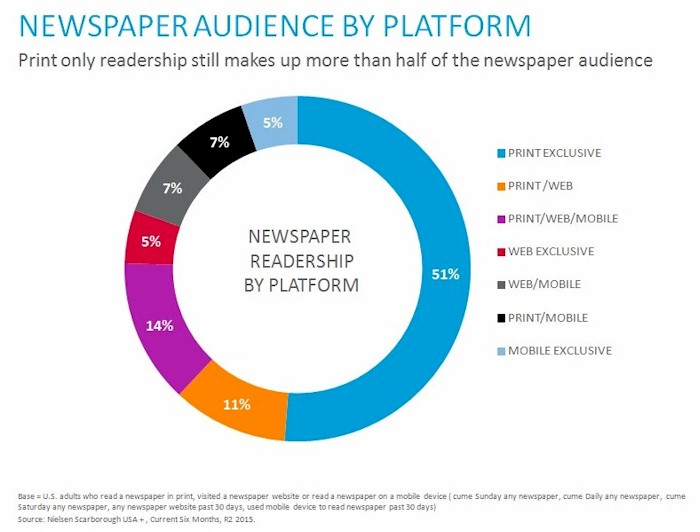


CHART ONE shows newspaper readership by platform. Note that the “Web Exclusive” is only 5%.


CHART TWO shows the readership by platform since 2011.  Note the decline in “Print Exclusive” and “Print/Web” over time.


CHART THREE shows the demographic breakdown of folks that read printed newspapers. Note the Age 50+ index.


______________________

PRPD BOARD SEEKS NEW CANDIDATES

Lynne Clendenin, Chair of the Public Radio Program Directors (PRPD) Nominating and Governance Committee, has notified PRPD members that the organization is now considering new Board candidates. PRPD members will vote on the Board seats between March 21 and March 25, 2016.

Three positions are up for election this year. One seat is open due to term limits (Jackie Sauter, North Country Public Radio) and two appointed board members (Jon Hoban, KJZZ and Kerri Hoffman, PRX) are running to maintain their seats on the board. Candidates may apply directly to PRPD or a member may nominate another member. PRPD requires Board members to either be employees of a member station or organizations or an individual member.

Other folks on the PRPD Board in addition to Clendenin are Board Chair Tamar Charney, NPR One, Board Secretary Abby Goldstein, WYEP and PRPD President Jody Evans (ex-officio); and members Bill Lueth, KDFC, Michael Arnold, Wisconsin Public Radio, Bill Anderson, KCUR, Ben Adler, KXJZ and Matt Abramovitz, WQXR.

Act now if you are interested. Applications must be received by Thursday, March 11, 2016. More information is available here.
_______________________

REMEMBERING CHARLIE TUNA


Radio lost one of its best DJs ever last week. The amazing Charlie Tuna died at age 71. He is perhaps best known as one of the Boss Jocks at KHJ in Los Angeles, a station that changed radio’s presentation style in the 1960s. KHJ heavily influenced popular culture by breaking artists such as The Byrds, The Mamas & Papas and rocking Bob Dylan.


I’ve always felt a bond with Charlie Tuna.  Like me, he grew up in Flyover Country – I love to folks from the middle-of-nowhere reach number one. I listened to Charlie (aka Art Ferguson) when he was on KOMA from Oklahoma City.  Charlie rocked the plains and prairies before he moved to LA.

Here is a tribute to Charlie Tuna that was posted on YouTube:


Video link: https://www.youtube.com/watch?v=0bIIt_0bvVc

Thursday, March 3, 2016

RADIO & AUDIO CAREERS DEPEND ON THE SKILLS EMPLOYERS SAY THEY WILL NEED


I saw an article in Radio World [link] that caught my eye: Three Radio Careers for the Next Generation by Dick Taylor. I have been reading Dick’s excellent blog [link] ever since I heard about it on Tom Taylor NOW [link].  Taylor is a longtime radio guy who is now passing along his knowledge to students at Western Kentucky University in Bowling Green.


Taylor’s blog goes behind the scenes of the commercial broadcasting biz. But it is not a retro site; instead it is focused on radio/audio now and in the near future. 

Recently Taylor and one of his students conducted a research project with the 
Kentucky Broadcast Association [link] and 
its 300 member stations.

A 
goal of the research was to understand how the jobs landscape for radio/audio newbies is changing. They looked at job skill trends in recent years and asked Kentucky broadcasters to project five years in the future.   

Taylor identified three core skills that are likely to grow.  Here they are in Taylor’s words plus my thoughts:


IN-DEMAND RADIO JOB SKILLS
1. Sales
The job most in demand will come as no surprise, I’m sure. Radio has a never-ending need for trained, professional sales people. Since I started in radio, it seems, a desire to hire good sales people has always been on the lips of general managers and sales managers.
For colleges, this represents an opportunity to offer more courses in this area for their broadcast majors. Radio stations have never had more products to sell. Beyond commercial air time, sponsorships and events, the amount of content that can be sponsored online has mushroomed.
KEN: Readers may think that sales aptitude is important only for folks who want to work in commercial radio/audio. But, knowing the basics of sales is important and an increasingly valuable for independent contractors and noncom workers.
So often when folks think of "sales" they picture stereotypes like Herb Tarlek from WKRP. Sales skills are more than that – they are an essential survival tools for the gig economy. Fundamentals such as how to prospect for new business, closing techniques and persuasion are universal human skills that can be applied anywhere.
2. Internet content creators
A second job that is growing in demand across the radio industry is for people who can create original content for radio station websites. Not cut-and-paste artists who “borrow” others’ website content and repurpose it, but innovators who can act as a combination journalist/advertising/public relations specialist and populate radio station websites with engaging, compelling original content that is of interest to people in the station’s service area.
KEN: Radio stations are becoming multi-platform content factories. Content is the variable that drives all media. How to implement and use research, the ability to put data in context and learning how to spot trends in demand.
3. RF broadcast engineers
Not that it has ever been easy to find great radio engineers, but the talent pool has changed. Consolidation chased a lot of them out of the business; others became consulting engineers to groups of radio stations. Computers and digital put new demands on radio engineers to learn new technologies or leave. Many who stayed or went into private consulting are now reaching the age of retirement.
KEN: I am a bit surprised to see this skill-set mentioned in Taylor’s research.  I hope it is true. “RF” means “radio frequency” – the basic distribution of content on wireless signals such as FM. Some observers say that broadcast radio will go away but I don’t agree. Radio has advantages over wired-media and is an ideal companion to many digital platforms and devices. Again, think of radio stations as content factories. Engineers are essential.
KENTUCKY BROADCASTERS’ RADIO TALENT INSTITUTE
This summer the Kentucky Broadcasters and WKU are hosting the 4th annual Radio Talent Institute workshop [link]. The Institute is an incubator and orientation to help identify and bring new talent into the radio/audio industry. 
  
It is a ten-day series of classes that cover the basics: on-air work, programming strategies, digital production and use of interactive media. Each participating student goes through sales training 101 and can become certified as Radio Marketing Professionals by the Radio Advertising Bureau (RAB). The certification is a ticket into media sales employment. According the KBA, 70% of the students with this certification and other essential skills get their first job in radio or a related field after graduation.

Students must apply today 3/4/16 to qualify.
website:http://kbawkuradiotalentinstitute.nationalradiotalentsystem.com


Wednesday, March 2, 2016

LOUISVILLE PUBLIC MEDIA: OVER 60 YEARS OF EXCELLENCE


This is an updated version of a post that first appeared on July 20, 2015.


Let’s shine a light on a noncommercial broadcaster that truly excels in public service, innovation and fiscal responsibility: Louisville Public Media (LPM) link.  


LPM provides an excellent example for all noncom broadcasters because their success is built great programming, wise leadership and putting the needs of listeners and community first – not narrow ideologies and inside agendas.

THE LOUISVILLE STORY

In 1949 the FCC granted a license for a new 10-watt FM station to the Louisville Public Library. WFPL FM 89.3 signed on in February 1950. During the early years WFPL concentrated on educational programming.

WFPL Began Broadcasting in 1950
These were tough years for FM broadcasting because the FCC moved all FM stations to a new part of the spectrum making existing receivers obsolete. Most commercial broadcasters gave up on FM. 

In 1952, Louisville’s powerhouse WAVA-AM donated its FM license, equipment and tower to Louisville Public Library.  The unbuilt station became WFPK FM 91.7.  The library was the first organization in the nation to own two FM licenses in the same market.  At the time WFPK aired classical music.

In 1976 the University of Louisville signed on WUOL FM 90.1.  WUOL also aired classical at that time.  

Gerry Weston, now GM at WICN, Worchester

In 1987, the Louisville Public Library cut ties to the stations because of budget problems. Manager Gerry Weston led the effort to create a new nonprofit organization to operate the two stations: Kentucky Public Radio.


ENTER LOUISVILLE PUBLIC MEDIA

By 1993 the University of Louisville decided to exit the radio business. WUOL was folded into Kentucky Public Radio, Inc. and operated as the Public Radio Partnership. (Kentucky Public Radio still the legal name of organization.)
 
LOUISVILLE PUBLIC MEDIA HQ


In 1996 LPM focused on a unique format for each of the three stations: NPR News 24/7 on WFPL, Triple A on 24/7 WFPK and Classical 24/7 on WUOL.


LPM had a successful $5,000,000 capital campaign and began broadcasting in 2000 from their new broadcast center in the heart of downtown Louisville.


 LOUISVILLE PUBLIC MEDIA TODAY

Donovan Reynolds
 In 2006 Donovan Reynolds became GM. In 2008 the organization’s operating name became Louisville Public Media. LPM puts community needs first and continues to grow.

 In tax year 2013, LPM had more than $5,467,000 in gross revenue. Expenses for the year totaled $4,759,000, providing an operating margin of over $700,000.

LPM’s 2013 revenue came from a healthy variety of sources. Pledging brought in around $1,700,000; underwriting was $1,900,000.  CPB provided $276,000 – a scant 5% of total.

All three of the stations do well in the Nielsen Audio ratings. According to the Fall 2015 data WFPL had 110,100 weekly cumulative listeners, WFPK had 62,400 and WUOL had 31,700. This is a very healthy cluster of stations. Reynolds and PDs Stacey Owen at WFPK, Daniel Gilliam at WUOL and WFPL Manager Editor Brendan McCarthy, are doing terrific work.