Monday, August 15, 2016

NIELSEN SPRING 2016 DIARY MARKETS: TRIPLE A & JAZZ STATIONS


Nielsen Audio’s Spring 2016 audience estimates showed notable gains in weekly listeners for the majority of Triple A/Rock and Jazz music stations compared to Spring 2015. The data, courtesy of the Radio Research Consortium (RRC), provides top-line information for publication. “Weekly cumulative listeners” is a key metric because it provides a snapshot of the total audience size.  (Scroll down to the ratings for Jazz music stations.)

TOP TRIPLE A/ROCK STATIONS DEMONSTRATE SUSTAINABILITY

Some station managers have said they don’t consider contemporary rock to be a viable format for them because they believe it doesn’t pay its way in medium and small markets. The top two full-time music stations – KWIR 89.7 The River and WNRN – prove this assumption is not true. According to financial documents on station websites, both stations are sustainable because of “listener sensitive” support: 67% of revenue in 2015 at KIWR and 81% at WNRN.

Strong underwriting revenue appears to be the key to financial stability.  Common wisdom is that younger listeners do not make pledges to the degree older listeners do to News and Classical music stations. So harvesting money from underwriting and events is crucial. Both KIWR and WNRN are deeply involved with their communities and solid track records of success for businesses.
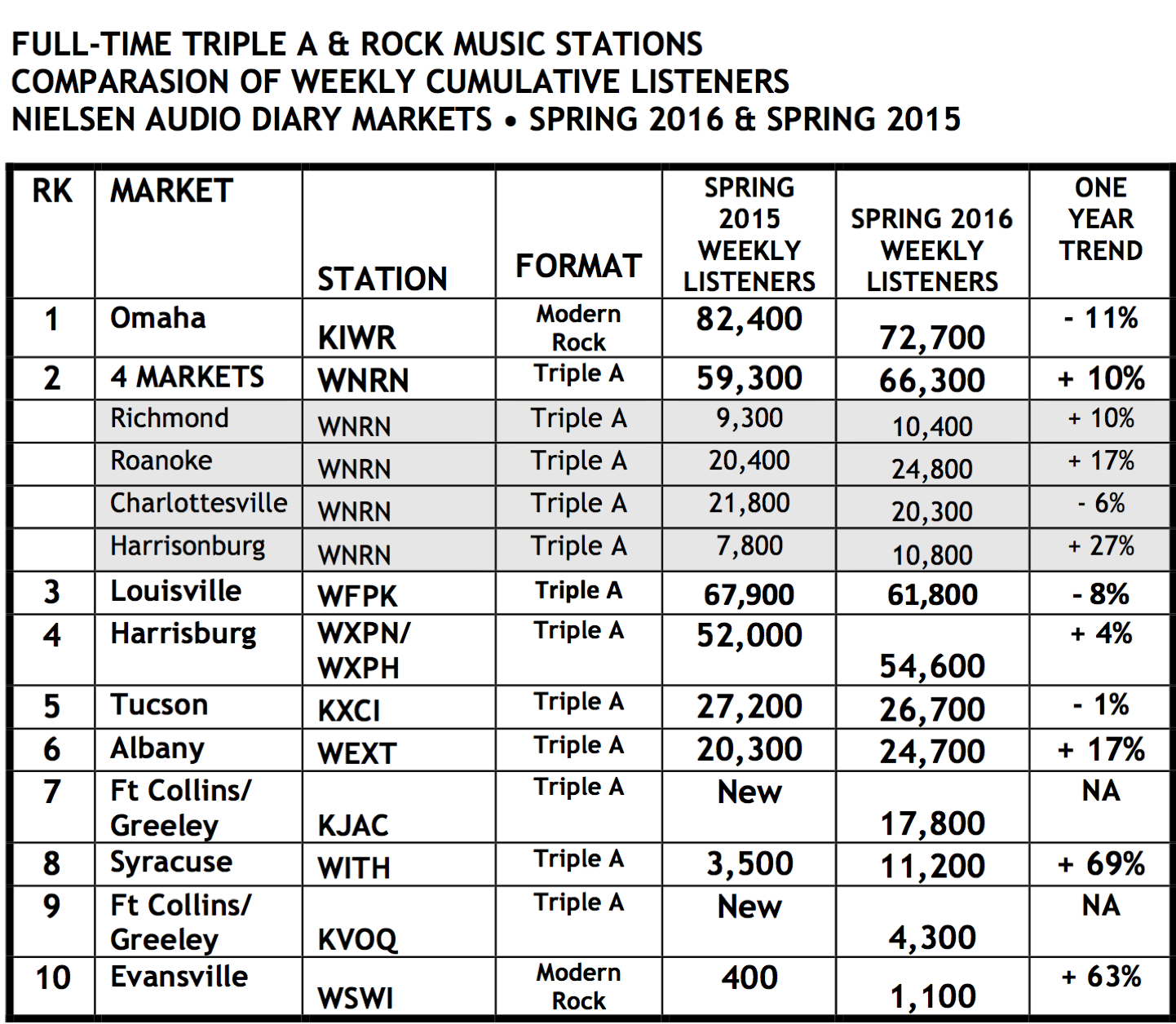


The number of estimated weekly listeners grew at five of the eight full-time music stations between Spring 2015 and Spring 2016. The number of weekly listeners declined at three stations.

WXPN’s repeater station in Harrisburg – WXPH – shows the value of secondary markets. WEXT, Albany had a nice gain in weekly listeners. KJAC, Greeley and KVOQ’s translator in Fort Collins are new since Spring 2015.

You gotta love #10 on the list: spunky WSWI in Evansville, Indiana.  WSWI, aka The Edge, has a small audience that appears to be growing. WSWI’s music mix is similar to KIWR’s.  Both stations concentrate on alternative and hard rock tunes popular with younger male listeners. Check out The Edge at [link].

There are several full-time Triple A stations that do not subscribe to the Nielsen ratings that likely have significant listening such as WAPS, Akron and WYCE, Grand Rapids.

WNCW & WOI-FM LEAD TRIPLE A DUAL FORMAT STATIONS

There is Nielsen date available for five dual format Triple A stations in Diary markets. All of them combine music with the major NPR News magazines. The top two have very different histories and approaches.

WNCW, licensed to tiny Spindale, North Carolina, has been a leader in bluegrass and Appalachian music and culture for three decades. WNCW has a regional presence far greater than most stations. WNCW now rocks harder than they did in the past.


WOI-FM seems like it woke up from a long nap. Since several Iowa stations merged a decade ago to form Iowa Public Radio (IPR) some of the best frequencies, particularly powerful KUNI, Cedar Falls, now air NPR News and Triple A called Studio One.

Nine stations makeup the Studio One network. Studio One relies primarily on syndicated programming such as UnderCurrents in addition to NPR News.


Triple A industry folks are keeping a close watch on WRUR, Rochester.  Parent organization WXXI is in the process of acquiring an FM translator for NPR News WXXI-AM. This move may allow WRUR to become a full-time music station.

_______________

KIOS, OMAHA LEADS JAZZ STATION WEEKLY LISTENER GAINS

Most Jazz music stations are located in larger markets measured by Nielsen Audio PPM methodology. Each of the Diary market Jazz stations have a different approach to the music.  KGOU, Oklahoma City airs lots of Blues.  WAER, Syracuse has a more traditional music mix.

Add caption
KIOS had the largest gains in weekly listeners in Diary markets that air jazz.  In many ways KIOS reminds me of KPLU (soon to become KNKX) because of strong commitments to both news and jazz programming.  

KIOS, owned by the Omaha Public School District, is becoming a strong news presence without sacrificing its Jazz heritage.   
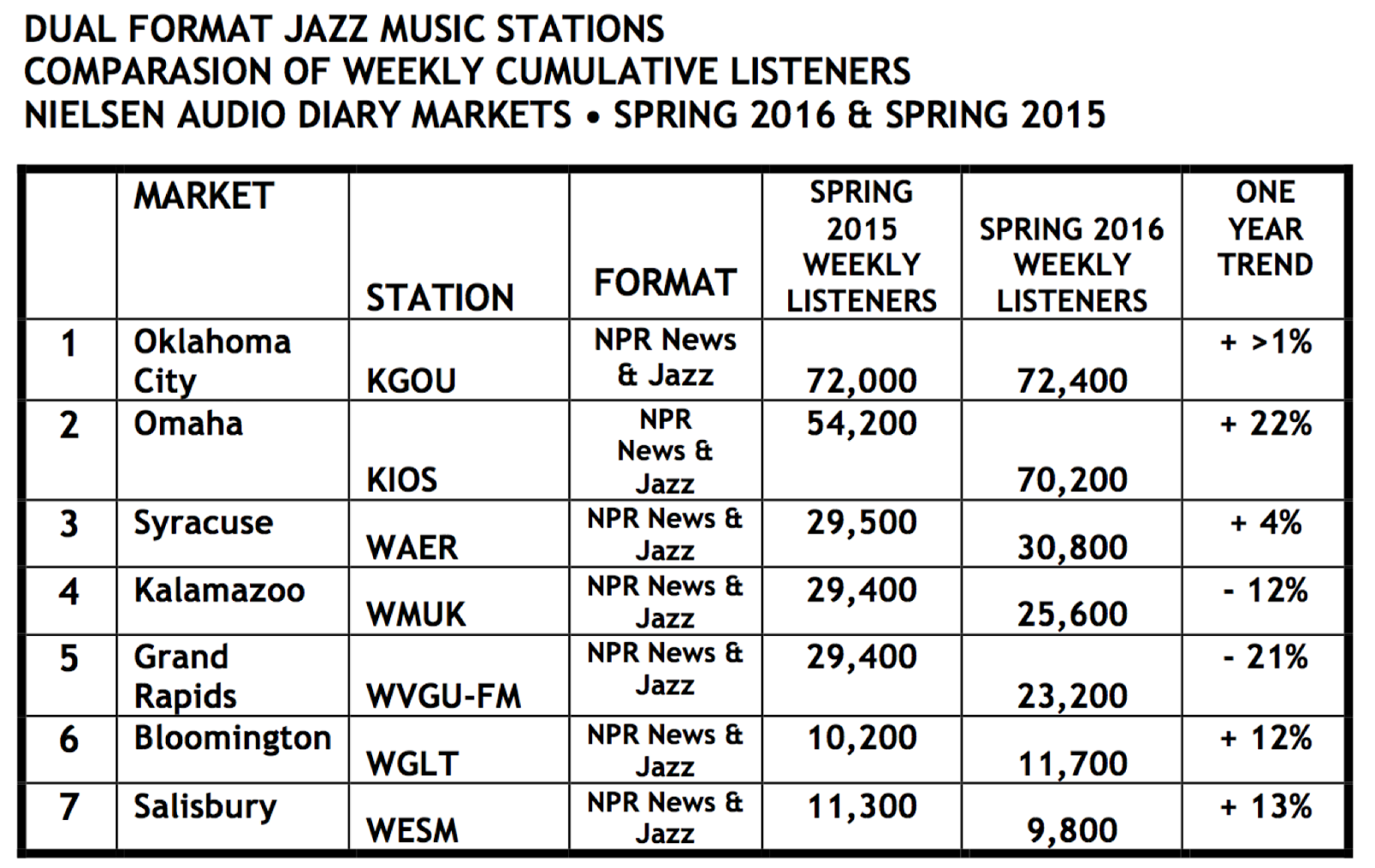


School district stations often have conflicts with their licensees.  KIOS, like WAPS in Akron and KHNC in Seattle, are exceptions because the school boards let professionals operate the stations with little interference.


There is not data available to assess full-time Jazz stations in Diary markets.

Monday-Sunday 6AM-Midnight Persons 12+
These data are provided for use by Nielsen subscribers ONLY,
in accordance with RRC's limited license with Nielsen Inc. Data Copyright Nielsen Inc. Format distinctions are the sole responsibility of Ken Mills Agency, LLC.

Friday, August 12, 2016

WHY RADIO IS SO RESILIENT, PART TWO


Adapted from a story originally posted on Monday, February 22, 2016.

There have been quite a few comments about my post on Tuesday [link] about various charts and graphs showing media usage.  Also, I’ve been reviewing Spring 2016 Nielsen Audio Diary market ratings. From what I’ve seen, radio is still hanging in there despite our constantly growing multi-platform multi-channel choices.

Baba Ram Das

Still, the predictions of the death of radio persist. Some folks want to live in a future they imagine.  Others want to Be Here Now. The phrase was coined by philosopher Baba Ram Das. [It is not often I get to quote stuff from my “underground” radio days.]

The essence of Be Here Now is to focus on what is happening in the current moment.  Of course, it is important to know the direction of the forest because it helps us plan for the future. But dwelling on life as it may be someday is as counter-productive as living in the past.

There is no doubt that digital technologies have changed the landscape for radio and other “old media.” Some traditional platforms such as magazines and newspapers are mere shadows of their former selves. However, two traditional “old” platforms – radio and TV – continue to be prominent in American life.

The two charts on the right reflect what I am talking about. The first chart is from Nielsen Audio’s most recent Comparable Metrics report.  Nielsen periodically publishes these cross-platform studies based on data for all of the platforms they track.  As you can see, broadcast radio and TV are widely used by adults of all ages. Radio even out-performs TV with folks ages 18 to 34.


The second chart, from Edison Research and Triton Digital, tracks the sources used to stay up-to-date on music – aka “Music Discovery.” Radio remains the top platform for this activity.  No single digital platform tops the bulk delivery of radio.  I think the data in this chart is important because “music discovery” is an active, listener-driven choice.  It is what people are doing right now. You can’t deny it, so Be Here Now.

THE CORE ATTRIBUTES OF RADIO

• CONTENT – People seek out what they want to see and hear based on its appeal and value to them. Radio has content that many people want experience frequently. Digital music services are getting hip to the value of curation and human voices.

• CONVENIENCE – Radio is King of the Car for good reasons: It offers information and entertainment with the least amount of work for the driver. Even though devices in “connected cars” can take you anywhere and do almost everything, traffic, weather and news is what people often want now.

• HABIT – Listening to the radio is a comfortable and familiar habit for many folks, particularly those over the age of 40. People change some habits over time but they don't change all of them. People keep habits that provide them value.

• COMPATIBILITY WITH OTHER PLATFORMS – Radio is a “close cousin” to many digital platforms and devices. In many ways, digital audio is still “radio” – voices and music coming from a box. Radio is adding video components, interaction and social media with increased sophistication. The ability to reach listeners via digital platforms increases audience reach and impact.

• LIVE MOMENTS – This may be radio’s least used asset.  It is all about Be Here Now. Examples range from the Super Bowl to “sig alerts” on the 405 to the latest about a great band coming to a club near you. It is exciting to be part of something when the outcome is unknown.

• IT’S FREE – “Free” is one of radio’s most powerful marketing advantages, particularly noncommercial public radio. The digital universe has become a non-stop shopping experience. Tracking, tollbooths, pop-ups and spam are everywhere. Radio is on digital platforms but it also is available directly via unwired signals.  A person doesn’t leave a footprint when listening to broadcast radio.

THE BIGGEST THREAT TO RADIO IS RADIO

The quickest way to kill radio is to not invest in new programming. Cable TV channels and streaming video producers have lots of new stuff in development. House of Cards didn’t happen over night – it took effort, time and money. Radio, including noncom public radio, invests too little time and resources developing new programming and grooming new talent.

Perhaps too much time and resources are being spent on peripheral activities like podcasting. Podcasts are certainly an important part of the media menu but they reach only a small fraction of the people hearing radio.

So Be Here Now is important for the future of radio.

Thursday, August 11, 2016

TOP 20 NONCOMMERCIAL STATIONS IN DIARY MARKETS


The Radio Research Consortium (RRC) is now almost finished distributing results from Nielsen Audio Diary markets for Spring 2016. As you probably know, Nielsen still uses written diaries to obtain in-tab listening in medium size and smaller markets. We are comparing estimated weekly cumulative listeners in Spring 2016 with Spring 2015.

Full-time NPR News stations (11) comprise over half of the Top 20.  There are 4 dual format stations, mainly NPR News & Classical.  Four of the Top 20 air Christian Contemporary Music (CCM) and one is full-time Classical music.


Most of the stations in the Top 20 added new estimated weekly listeners in the year since Spring 2015. Fourteen (70%) gained weekly listeners and 6 (30%) lost weekly listeners.

Stations airing NPR News are probably getting a “bump” from coverage of politics. The task now will be to keep these folks coming back after the elections.

Note stations in the Top 20 who far exceed their market size. WVPR – Vermont Public Radio News – is in Burlington, Nielsen audio market #144. They have more estimated weekly listeners than WFPL, Louisville (#55), WBFO, Buffalo (#57), KUAZ, Tucson (#62) and WAMC, Albany (#65).

Please keep in mind that Nielsen only published data for stations that subscribe to the ratings. Look for complete Diary market by format next week on Spark! starting with Triple A stations on Monday 8/15.

PRAISE FOR STEVE ROBINSON AS HE RETIRES FROM WFMT

Earlier this week Chicago Tribune media writer Robert Feder broke the news [link] that Steve Robinson is stepping down after 16 years as executive vice president and general manager of classical WFMT. Robinson told Feder: 

Steve Robinson


Working at WFMT and the WFMT Radio Network has been the greatest privilege and challenge of my career. When people ask, ‘Oh, you run WFMT?’ I always say, ‘No, I run after it.’ And that’s because everyone at WFMT is immensely creative, knowledgeable, and passionate about their work, and all I’ve really done is try to harness this incredible talent to move the station forward.


CHICAGOAN OF THE YEAR!

Praise for Robinson is now pouring in.  The Chicago Business Journal [link] said:

Robinson was adamant in his efforts to ensure WFMT stood apart. [His] on-air announcers were a breed unto themselves — seemingly taking great delight every time they were required to effortlessly rattle off the fiendishly difficult names of classical music composers and artists.

Classical industry observers credited Robinson for occasionally airing obscure and challenging pieces. Business folks mentioned his strength in planning and hosting WFMT’s pledge drives that raised hundreds of thousands of dollars in short periods of time. Radio biz folks cite his work on the WFMT Radio Network, a syndication service that is thriving.

Though he was born and raised in Boston, Robinson embraced Chicago like a native.  In 2007, the Chicago Tribune named him  “Chicagoan of the Year” in part because of his work to establish the Studs Terkel Radio Archive in conjunction with the Chicago History Museum.

THE JOURNEY FROM NEBRASKA TO ST. LOUIS AVENUE

I first got to know Steve Robinson in the early 2000s when he was head of Nebraska Public Radio Network and general manager of KUCV in Lincoln, Nebraska. I was in Lincoln doing consulting work for a client and I stopped by KUCV to see him.

That visit began a conversation with Robinson we are still having to this day. Robinson has mentored hundreds of folks including future APM executive Chris Kotz who started out working for him in Lincoln.

Speaking of Nebraska, I saw this post about him on the Chicago Tribune website from reader Randall Bretz:

I applaud your paper for recognizing Steve Robinson. He's a spark that ignites those around him. I watched and worked with Steve as he took Nebraska Public Radio from a single signal in the Capitol City to a state-wide network that touched all the people in the state. He did it with enthusiasm and excitement that helped create a real gem in our broadcasting service for the state. We miss him. The people of Chicago are fortunate to have him!

Robinson’s last day at WFMT will be September 30th. After leaving the station he plans to “stretch his entrepreneurial wings